

Think about the small annoyances that quietly eat away at a typical workday. A team walks into a conference room and spends the first eight minutes hunting for a compatible HDMI adapter. An employee commutes forty minutes into headquarters only to discover every quiet desk near their department is already taken. By mid-afternoon, the fourth-floor meeting room feels stuffy and dim, leaving everyone struggling to stay sharp through a critical planning session.
Individually, these moments barely register as problems. Multiplied across a hundred employees over a full year, they drain thousands of productive hours and make coming into the office feel like an obstacle course.
That is where smart office technology earns its keep. Rather than filling a floor plan with flashy gadgets, modern workplace tech uses connected sensors, automated building systems, and intuitive software to remove everyday friction. When an office quietly adapts to the people working inside it, teams get more done with less wasted energy, and companies get far more value out of their real estate.
Removing Daily Friction Through Intelligent Space Management
Hybrid work permanently changed how physical offices operate. Attendance no longer stays flat from Monday through Friday; instead, buildings sit half-empty on Mondays and Fridays and surge to near capacity on Tuesdays and Wednesdays. Managing that fluctuation with static seating charts or shared spreadsheets quickly turns chaotic.
Smart space management platforms bring order to flexible schedules. Employees can open a mobile app before leaving home, view a live floor map, and reserve a desk near the teammates they need to collaborate with that day. If an engineer needs a dual-monitor workstation and a sales rep needs a quiet booth for client calls, both can lock in the right setup in seconds.
Connected occupancy sensors take this efficiency a step further by eliminating ghost meetings—conference rooms booked on a calendar for an hour that nobody actually shows up to use. When a room sensor detects no movement ten minutes past a meeting’s start time, the system automatically cancels the reservation and flips the wall panel outside the door from red to green. People stop wandering hallways peering through glass walls, and existing meeting space stretches much further without adding a single square foot of real estate.
Upgrading Collaboration With Frictionless Meeting Room Tech
Few things derail momentum faster than technical trouble at the start of a meeting. With distributed teams now the norm, almost every conference room conversation includes at least one remote participant. Older setups that require manually pairing laptops, toggling audio inputs, and huddling around a single tabletop speakerphone turn routine check-ins into exercises in frustration.
Modern smart meeting rooms are built around one-touch join capabilities and wireless content sharing. Walking into a room and tapping a single screen launches the video call instantly, bypassing dongle hunts and software updates. Intelligent cameras automatically frame active speakers and adjust wide angles so remote colleagues can read facial expressions and body language clearly rather than staring at a distant, static shot of a long table.
Audio upgrades matter even more than video. Ceiling-mounted beamforming microphones isolate human voices while filtering out keyboard clicks, HVAC hum, and chair squeaks. Paired with interactive digital whiteboards that save notes directly to cloud workspaces, teams can finish a brainstorming session and walk out with organized action items already shared, rather than snapping blurry smartphone photos of dry-erase markers.
Creating Healthier, Focus-Friendly Environments Automatically
Most companies invest heavily in software licenses and ergonomic chairs while overlooking the basic physical environment inside their walls. Lighting, indoor air quality, temperature, and background noise have a direct, measurable impact on cognitive stamina, concentration, and mood.
Adaptive Lighting and Climate Control
Harsh overhead fluorescent lighting and wildly inconsistent thermostats are classic workplace complaints. Smart building systems replace fixed settings with circadian lighting and zoned HVAC controls. Lighting fixtures gradually shift color temperature and brightness throughout the day, mimicking natural daylight—cooler, brighter light in the morning to support alertness, transitioning to warmer tones in the late afternoon to reduce eye strain. At the same time, localized temperature controls keep individual zones comfortable based on actual headcount, preventing a packed conference room from turning into a sauna while an empty open floor freezes.
Air Quality Monitoring and Acoustic Management
Afternoon fatigue is frequently blamed on heavy lunches, yet elevated carbon dioxide levels in closed meeting rooms are often the real culprit. Smart environmental sensors continuously monitor CO2, humidity, and volatile organic compounds, automatically ramping up fresh air circulation before stuffiness dulls decision-making. In open-concept offices where hallway chatter easily disrupts deep focus, adaptive sound-masking systems emit subtle, calibrated ambient noise that softens speech intelligibility across neighboring desks without feeling intrusive.
Cutting Energy Waste and Lowering Operating Overhead
Workplace efficiency is not limited to employee output; it also shows up directly on the balance sheet. Heating, cooling, and lighting an entire office floor for twelve hours a day when only thirty percent of the desks are occupied is an expensive habit.
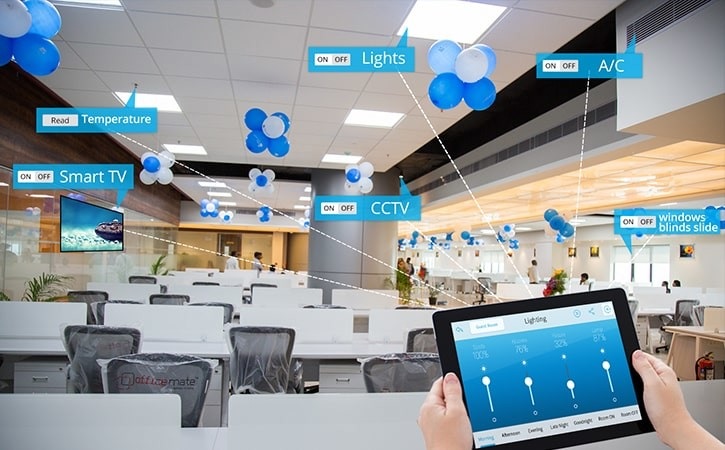
Smart office infrastructure ties utility consumption directly to real-time presence. Automated lighting dims or shuts off in unoccupied zones, motorized shades lower automatically when afternoon glare hits west-facing windows to reduce cooling loads, and HVAC systems scale back airflow in empty wings on low-attendance days.
The same connected intelligence transforms building maintenance from reactive repair to predictive facilities management. IoT sensors embedded in chillers, air handlers, water lines, and electrical panels monitor performance continuously. If a cooling unit starts drawing abnormal power or a pipe shows early signs of a leak, facilities teams receive an alert days before an outage occurs. Fixing a worn component over the weekend costs a fraction of shutting down an office floor on a Wednesday morning for an emergency repair.
Using Occupancy Data to Optimize Real Estate
For most growing organizations, commercial rent sits right behind payroll as the largest fixed operating expense. Yet until recently, decisions about how much space to lease—and how to design it—relied mostly on rough estimates and anecdotal complaints.
Smart workplace analytics replace guesswork with anonymized utilization data. Over a few months, occupancy sensors reveal how employees genuinely use the building. Leadership might discover that their twelve-person executive boardrooms are used by groups of three or four people eighty percent of the time, while two-person focus rooms and phone booths are booked solid from nine to five.
Armed with real usage patterns, companies can reconfigure floor plans to match actual work habits—converting underused large rooms into agile huddle spaces, adjusting catering and cleaning schedules to match peak attendance days, and making informed decisions before renewing or downsizing a multi-year lease.
Streamlining Security, Visitor Management, and Daily Operations
A productive office feels effortless from the moment someone walks through the front lobby. Outdated paper sign-in clipboards, easily lost plastic keycards, and manual IT request forms create unnecessary bottlenecks for both staff and guests.
Smart access control allows employees to unlock doors, call elevators, and release secure print jobs using encrypted mobile credentials on their smartphones or smartwatches. Onboarding a new hire or revoking access when someone leaves takes seconds from a central dashboard instead of tracking down physical badges.
At reception, digital visitor management kiosks let guests check in quickly, sign required nondisclosure agreements, print temporary badges, and notify their host automatically via chat or text. Meanwhile, simplified workplace ticketing—such as scanning a QR code on a broken monitor or tapping a room panel to flag a missing whiteboard marker—routes minor maintenance issues straight to facilities or IT without requiring employees to log into a clunky helpdesk portal.
Implementing Smart Office Technology Without Overwhelming Your Team
The smartest workplaces rarely feel overly technical. In fact, the surest sign of a poorly executed smart office rollout is an employee having to download four separate apps just to book a room, open the front door, and turn on a projector.
Companies that see the strongest return on workplace technology follow a few practical guardrails. They start by identifying the specific friction points slowing their teams down rather than buying connected hardware for its own sake. They insist on open integrations so room booking, calendar tools, access control, and video conferencing work together seamlessly behind the scenes.
Equally important is being transparent about employee privacy. Occupancy analytics should measure spaces, never individuals. Communicating clearly that sensors track anonymous room usage—not who is sitting at which desk and for how long—builds trust and ensures staff actually embrace the tools designed to help them.
When thoughtfully deployed, smart office technology fades quietly into the background. Meetings start on time, workspaces stay comfortable and well-lit, real estate budgets stretch further, and teams spend their energy on meaningful work instead of wrestling with the building around them.